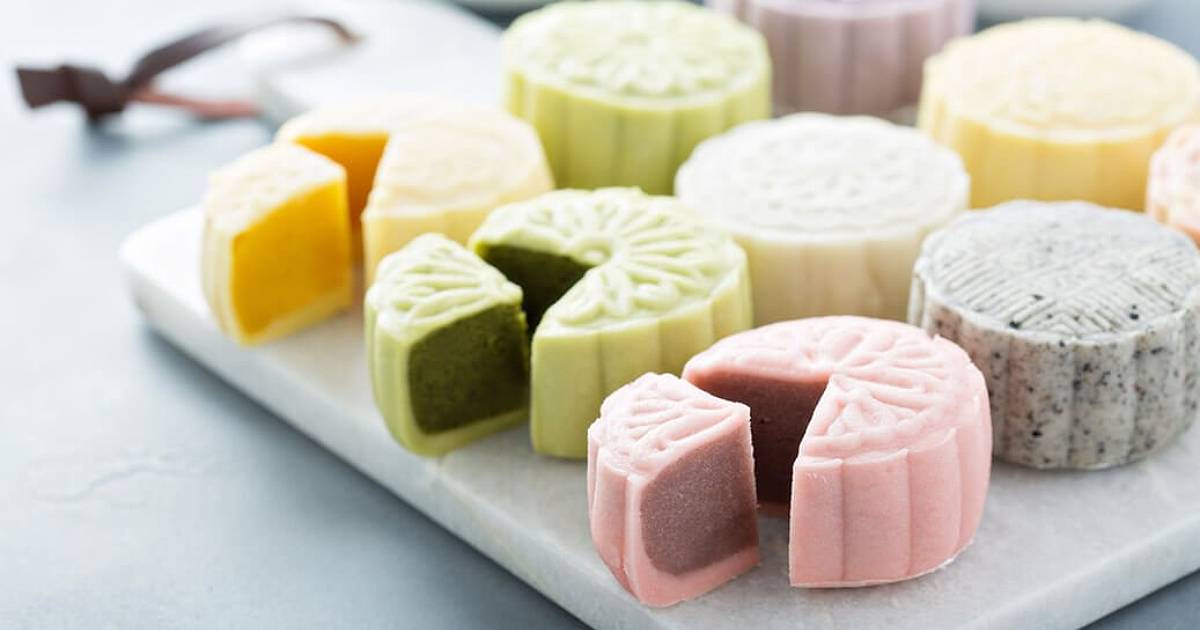
What is a moon cake?
A mooncake (月餅) is a traditional bakery product prominently enjoyed during the Mid-Autumn Festival (中秋節) in various Asian countries. This festival revolves around lunar appreciation and moon watching, with mooncakes standing as a revered delicacy exchanged among friends and family during the celebrations.
Mooncakes typically take the form of round pastries with a sumptuous and thick filling, often crafted from red bean paste or lotus seed paste, encased in a delicate 2–3 mm crust. Some variations may feature yolks from salted duck eggs, symbolizing the full moon. Traditional mooncakes bear imprints on the top, showcasing Chinese characters symbolizing "longevity" or "harmony," along with the bakery's name and the specific filling. Additional artistic touches may include imprints of the Moon, Lady Chang'e on the Moon, flowers, vines, or a rabbit—symbolic of the Moon. Mooncakes play an integral role in the cultural and culinary experience of the Mid-Autumn Festival, enriching the festivities with their symbolic meanings and delightful flavors
Traditional mooncake fillings
Lotus seed paste (蓮蓉)
Considered by some to be the original and most luxurious mooncake filling. White lotus paste is even more premium. Sometimes, white kidney bean paste is used as a filler due to the high price of lotus paste.
Sweet bean paste (豆沙)
There are various pastes commonly used as fillings in Chinese desserts. While red bean paste made from azuki beans is the most common worldwide, regional preferences exist for bean paste made from mung beans or black beans.
Jujube paste (棗泥)
This sweet paste is made from ripe jujube (date) fruits. It has a dark red color, a slightly fruity/smoky flavor, and a slightly sour taste.
Five kernels (五仁) or mixed nuts
A filling made of coarsely chopped nuts and seeds, held together with maltose syrup. Different regions use various nuts and seeds such as walnuts, pumpkin seeds, watermelon seeds, peanuts, sesame seeds, or almonds. Candied winter melon or rock sugar pieces are often added for additional flavoring.
Mooncake crusts
Mooncake crusts vary widely depending on the region where they are produced. Most regions have many types of fillings but only one type of crust. While vegetarian mooncakes may use vegetable oil, many mooncakes use lard.
The most popular types of crusts are:
Chewy
This crust, commonly used in Cantonese-style (Hong Kong style) mooncakes, has a reddish-brown tone and glossy sheen. It is made using a combination of thick sugar syrup, lye water, flour, and oil, resulting in a rich taste and a chewy yet tender texture. Maltose syrup can be added to increase chewiness.
Flaky
Flaky crusts are indicative of Suzhou- and Taiwan-style mooncakes. The dough is made by rolling alternating layers of oily dough and flour that has been stir-fried in oil, resulting in a texture similar to puff pastry.
Tender
Mooncakes from certain provinces of China, such as Shanghai-style mooncakes, have a tender crust instead of a flaky or chewy one. The texture of this crust is similar to the shortcrust pastry used in Western pie crusts or tart shells. It is made with a mixture of sugar, oil, flour, and water. This type of crust is also commonly used in other types of Chinese pastries, such as egg tarts.
Crumbly
Yunnan-style mooncakes have a dense, crumbly crust made using a hot water crust pastry that combines different kinds of flour with oil, salt, and hot water. This type of crust is uncommon in other regions.
Less traditional types of mooncake crusts can be made with:
Glutinous rice
This crust has a texture similar to mochi and is known colloquially as "snowskin mooncakes".
Jelly
A crust made from gelling mixtures such as agar, gelatin, or konjac, flavored with a wide variety of fruit flavors.
 |
| Left: Hong Kong style mooncake with banana filling Right: Taiwanese style mooncake with red bean paste and salted egg yolk |
 |
| Thousand layer mooncake with taro and egg yolk Photo by: whisknfold.com |
 |
| No bake mooncakes with outer layer made of jelly Photo by: eatwhattonight.com |
Snow skin mooncake
Snow skin mooncakes are a variation of traditional mooncakes originating from Hong Kong but now popular in several Asian countries including Macau, Mainland China, Taiwan, Vietnam, Singapore, Malaysia, and Indonesia. Unlike traditional mooncakes that are baked, snow skin mooncakes are not baked and are typically enjoyed cold.
Emerging in the 1960s as an alternative to traditional mooncakes, snow skin mooncakes were created by a bakery in Hong Kong to address concerns about the high sugar and oil content in traditional mooncakes. To reduce the fat content, the bakery used fruit fillings and reduced the oil content in the crust. By the 1970s, snow skin mooncakes gained popularity and were also known as "crystal mooncakes" (水晶月饼). The term "Bing Pi Yue Bing" (冰皮月饼) appeared in advertisements in the early 1980s.
The crust of snow skin mooncakes is made from glutinous rice, similar to the crusts used in mochi ice cream or yukimi daifuku. These mooncakes are typically white in color and served cold, hence the name "snow skin." However, they can have other colors due to added flavors in the crust.
Snow skin mooncakes offer a variety of fillings, including mung bean paste, fruit, green tea, jam, strawberry, chocolate, coffee, and cheese. Other popular flavors include durian, sesame, mango pomelo sago, and purple yam. These diverse fillings contribute to the wide range of flavors and textures found in snow skin mooncakes, making them a beloved treat during the Mid-Autumn Festival and beyond.
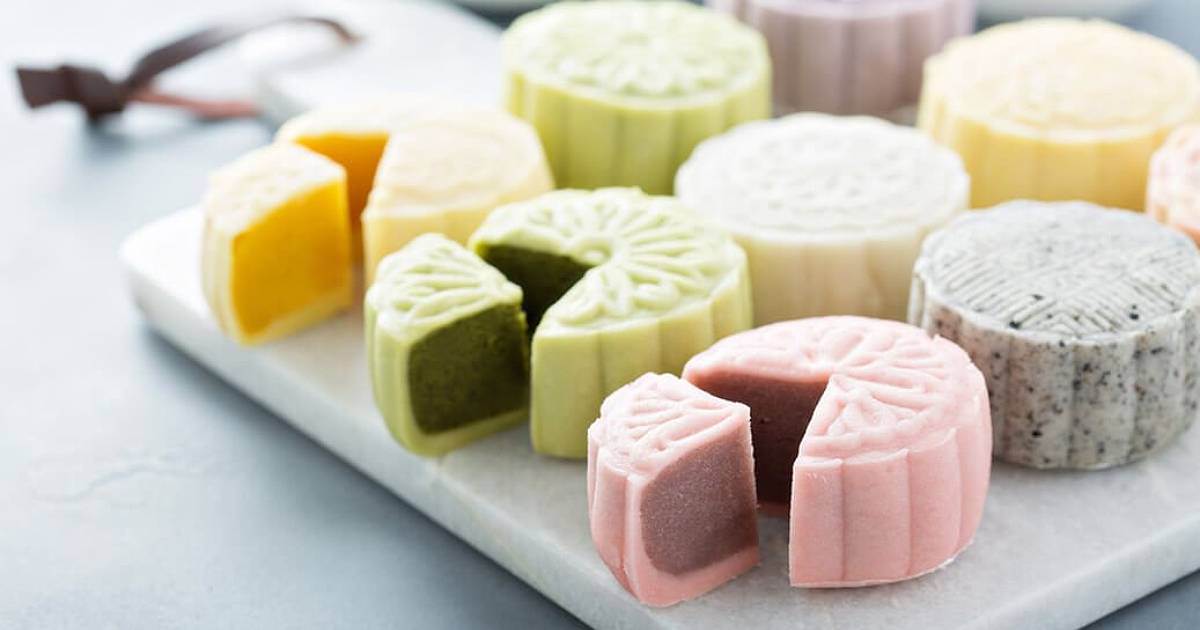 |
| Snow skin mooncakes Photo by: eastcoastpodiatry.sg |